
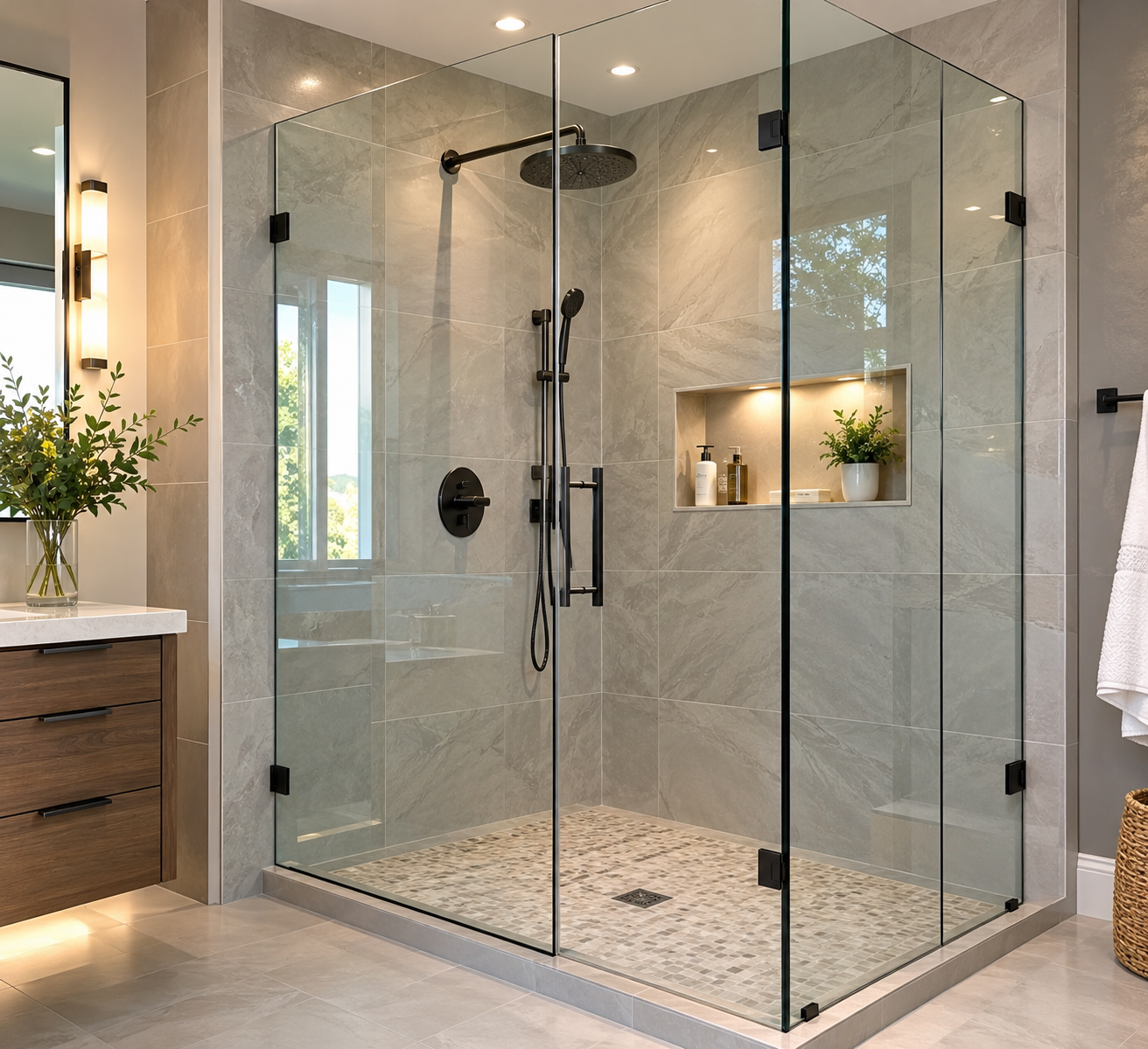
A puddle outside the shower can mean very different things, and the floor won’t tell you which. Water slipping under a worn door sweep is a cheap fix. Water that shows up even when the shower is aimed at the far wall may be coming from a failed pan or a leaking supply line, and that one shouldn’t be mopped up and forgotten.
All of these causes leave the same evidence: a damp bath mat, a slick patch near the hinge, a wet strip along the threshold. Before buying anything, work out where the water leaves the enclosure and why. A new sweep won’t help if the real culprit is a showerhead that blasts the glass at a steep angle, and a showerhead adjustment won’t help if the curb slopes outward.
Where the Water Actually Comes From
Water gets out of a shower enclosure in a handful of ways:
- Under the door. Frameless doors need a gap at the bottom to swing without scraping the curb. Water running down the glass reaches that gap, and if the sweep is missing, worn, or the wrong size, it drips or runs through.
- Around the edges. Hinged doors have narrow vertical gaps at the hinge side and the latch side, plus a seam between the door and any fixed panel. Spray aimed at these seams goes straight through.
- Over the top of the curb. If the curb is low, flat, or sloped slightly outward, water spreads over it instead of draining back in.
- Out of the track. On sliding (bypass) doors, the bottom track collects water and is supposed to drain it back into the shower through small weep holes. Clogged holes make the track overflow.
- From the drain. A slow drain lets water rise in the pan until it reaches the curb.
A sixth category is not about the door at all: the floor outside may slope toward the shower, or the water may come from a leak somewhere else, like the toilet supply line or a sink drain. Because both fool people, the diagnosis comes first.
A 15-Minute Test That Narrows It Down
You need a dry towel, a flashlight, a plastic cup, and a phone to take pictures. Wipe the floor and the bottom edge of the door completely dry, then work through these in order.
Look first. Shine the light along the bottom of the door and the curb. Note the sweep’s condition: cracked, flattened, peeling away, or missing entirely. Look for black or pink film in the track, gaps in the caulk, and any place where the curb looks lower or crooked.
Run the shower with the spray aimed at the wall. Point the showerhead away from the door and run it for a few minutes with the door closed. If the floor stays dry, the water is probably reaching the gaps by direct spray or by running down the glass. If the floor still gets wet, keep reading, because the problem lies elsewhere.
Test the seams one at a time. With the shower off, pour a cup of water slowly down the glass at the hinge side, then the latch side, then the middle. Watch where the water runs and where it drips. A cup poured onto the glass 6 inches above the sweep shows whether the sweep is doing its job. A cup poured into the track on a sliding door shows whether the weep holes drain.
Watch the drain. Run the shower for two to three minutes. If water rises and pools around the drain instead of vanishing quickly, the drain is a suspect.
Check whether the shower is even involved. Put dry paper towels in the puddle area without using the shower for a day. If they get damp, the water is coming from a source other than the shower, such as the toilet, the sink, or a pipe in the wall.
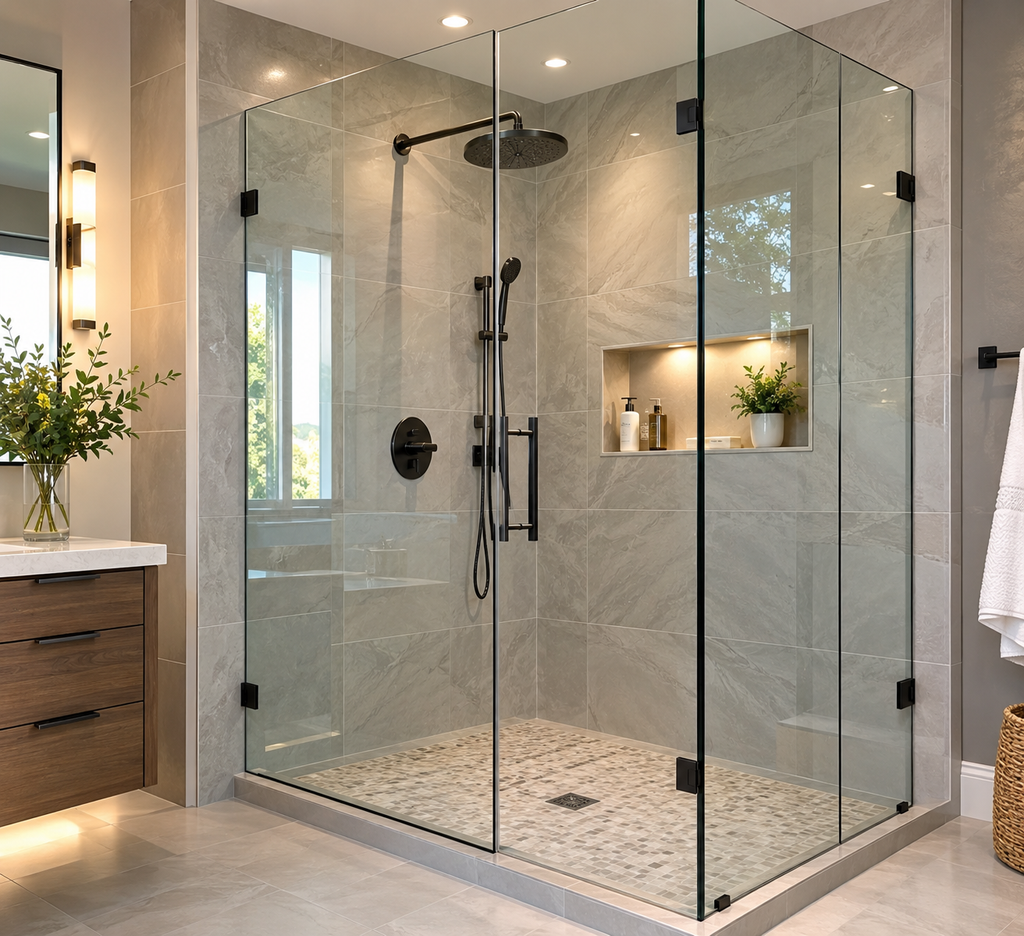
Here is how to read the results:
| What you see | Most likely cause |
| Wet floor only when the spray hits the door | Showerhead aim, door gaps, or worn sweep |
| Water runs out right at the bottom edge of the glass | Failed sweep or an oversized bottom gap |
| Wet at the hinge or panel seam only | Failed seam seal or hinge gap |
| Sliding door overflows in the track | Clogged weep holes or cracked track seal |
| Water pools in the pan, then spills | Slow drain |
| Wet with the shower off, or wet when aimed away | Leak elsewhere or water migrating from the pan |
When the Spray Itself Is the Problem
Showerhead position decides how much water ever reaches the door. A fixed head angled outward, a rain head too close to the glass, or body sprays facing the door all send water at the weakest part of the enclosure. Most doors are designed on the assumption that the spray lands inside.
Pressure matters too. A high-flow head produces more rebound and mist, which wets the glass much higher than a standard head. If a recent showerhead swap coincided with the puddle, the old head’s lower throw may have been what kept the floor dry. A handheld on a bar makes it easy to aim water downward.
Small enclosures also leave less room for error. In a 30-inch-wide stall, someone standing near the door can push water toward the seam just by turning around. Notice who uses the shower: if the puddle only appears after one household member showers, the explanation may be as simple as where they stand or how they angle the head.
A Worn, Missing, or Wrong Door Sweep
The door sweep is the strip along the bottom of the glass, and it’s the most common reason for a puddle. Sweeps wear out. The flexible fin or bulb loses its shape, mineral deposits harden it, or it simply pulls off the glass.
There are several designs, and the difference matters when replacing one:
- Fin or wipe sweeps have a thin blade that brushes the curb. They block splashes but not much running water.
- Bulb sweeps have a rounded tube at the bottom that compresses against the curb and makes a better seal.
- Drip rails (a rigid plastic or aluminum strip with a lip) direct water back inward instead of letting it run off the bottom. They work well against water sheeting down the glass, and are commonly combined with a flexible fin.
- Wrap-around sweeps hold the glass on both faces and carry the drip rail on the inside.
Sweeps fit specific glass thicknesses. Frameless glass commonly comes in 3/8 inch or 1/2 inch, and some 1/4 inch glass exists, but check your door rather than assuming. Measure the thickness with a ruler or caliper at an edge. A sweep that is meant for thinner glass will fall off, and one made for thicker glass won’t grip.
A sweep that is too long or too stiff drags on the curb and wears quickly. One that is too short leaves a gap at the end. Another subtle mistake is a sweep that seals perfectly but sits too high: it still leaves a gap for water to escape underneath.
If the old sweep looks intact but the water still gets through, test the gap. Close the door and slide a sheet of paper under the bottom edge. If it slides through freely along the whole width, the sweep isn’t closing the gap. Some doors have a bottom gap large enough that a fin sweep alone can’t cover it, and they need a taller sweep or a drip rail with a deeper skirt. Manufacturers don’t all agree on gap sizes, so use the sweep’s own specification as the guide.
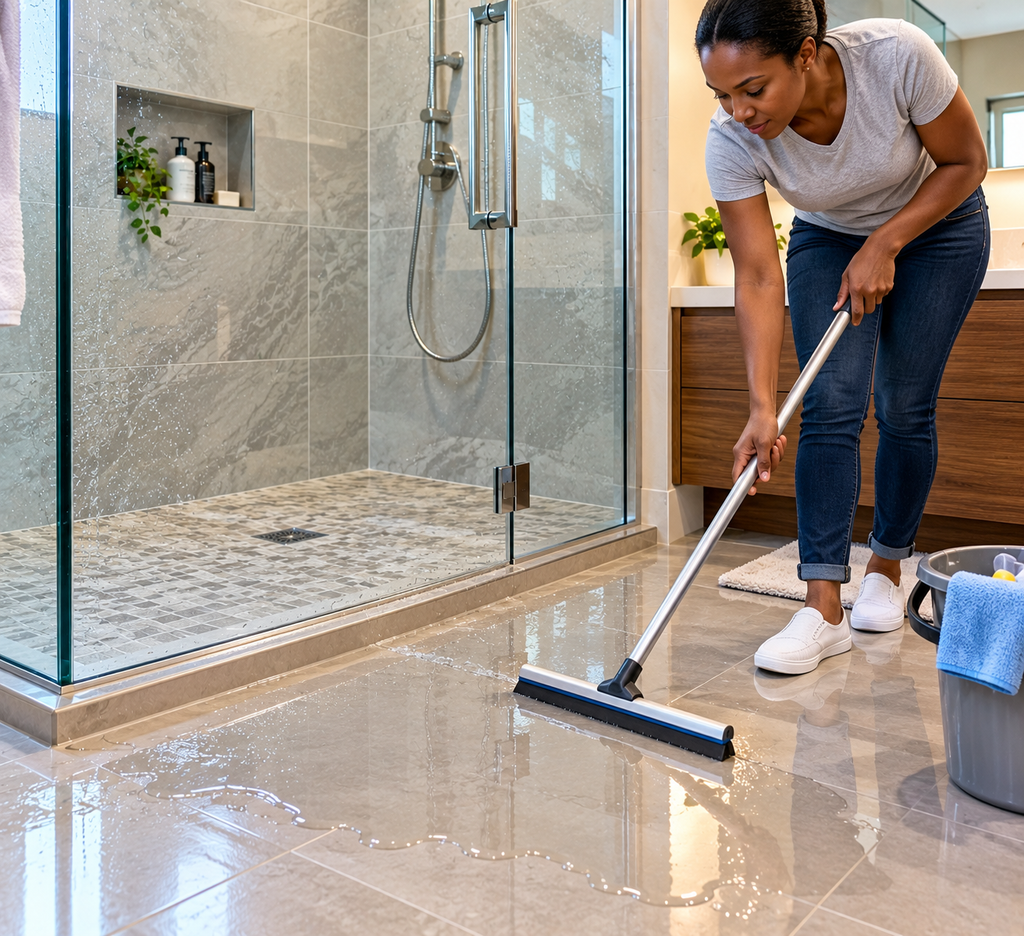
Gaps at Hinges, Panels, and Door Edges
Hinged doors have narrow vertical gaps along the hinge side and the strike side. These exist so the door can swing without binding, but they are also pathways for spray. On frameless designs, the hinge gap is usually left open, and some installations include a clear vinyl seal strip that fits the edge of the glass.
Check these places:
- The hinge edge. Water that hits the hinge gap from inside slides out between the door and the wall or fixed panel.
- The magnetic or latch strip. Many doors close against a magnet with a clear seal. If the seal has curled or the magnet no longer pulls, the door can sit slightly open.
- The seam between door and fixed panel. A hinged door beside a fixed glass panel often has a small gap along the seam, usually sealed with a vinyl strip.
If a hinge seam leaks, a replacement vinyl strip designed for your glass thickness is the usual fix. These come in several shapes and aren’t interchangeable, and some are specific to certain brands. Bring a photo and the glass thickness to a hardware store, or search by the door manufacturer’s name and model.
Also check whether the door is hanging properly. A door that sags a quarter inch on its hinges leaves a wider gap at the latch side than it did when installed. Hinges on heavy glass can loosen over time. Adjusting them is a job for two people, because tempered glass is heavy and the edges chip easily.
Sliding Doors: Clogged Tracks and Blocked Weep Holes
Bypass doors sit in a track along the top of the curb. Water that runs down the glass lands in the track, and the track is supposed to drain it back into the shower through small slots called weep holes. When soap scum, hair, and mineral deposits fill the holes, the track fills up and overflows toward the outside.
Check the track with a flashlight. Standing water that stays after a shower, or a gray film packed into the corners, is a clue. Clean it with a toothbrush and a plastic pick. A cotton swab can clear the weep holes. Mild dish soap works well on soap scum. Some people reach for bleach or a strong cleaner, but avoid mixing products. Never combine bleach with ammonia or acidic cleaners, since the mix can release hazardous gases, and ventilate the room whenever you use a cleaner.
Other sliding-door problems to look for:
- Cracked or missing track seal. Where the track meets the curb, a bead of sealant keeps water from getting under. If it has failed, water can run along the underside of the track. Manufacturers commonly suggest sealing the outer edge of the track and leaving the inner edge open so water in the track can drain back in. Check your instructions, since designs vary.
- Worn bottom guides or wheels. A door that rides crooked leaves uneven gaps.
- Bottom wipers on the door panel. These are small and easy to overlook, but they are what keeps water inside the track.
A Curb That Slopes the Wrong Way, or Sits Too Low
Water that reaches the curb should run back inward. That depends on a pan or floor that slopes toward the drain and a curb whose top surface slopes slightly inward or at least stays level. If the surface tilts outward, or if settling has changed the angle, water crosses the curb on its own.
You can check with a small level or a marble. Set the level on top of the curb: the bubble should show a level or slight inward lean. A marble placed on the curb should roll inward or stay put. If it rolls outward, water will follow.
The shower floor itself also needs a slope. A common guideline for tiled shower floors is about 1/4 inch of fall per foot toward the drain, but confirm the exact requirement with the tile setter, your local building code, or the manufacturer of your pan. Shallow slopes leave puddles that can slosh over the curb when someone steps in.
Curb height is another factor. Low curbs are easier to step over but offer less protection, and some bathrooms were built with a threshold that was only a half inch or so above the floor. If your shower never had much of a dam, small changes, such as a heavier flow or a new door, can tip it over the edge.
None of this is easy to fix cheaply. If the curb is truly sloped outward, options include adding a thicker threshold or a retrofit dam, or having a tile setter rebuild it. This is a remodel-level decision, and if the slope is significant, a waterproofing contractor should look at it, because grinding down or building up a curb affects the waterproof layer under the tile.
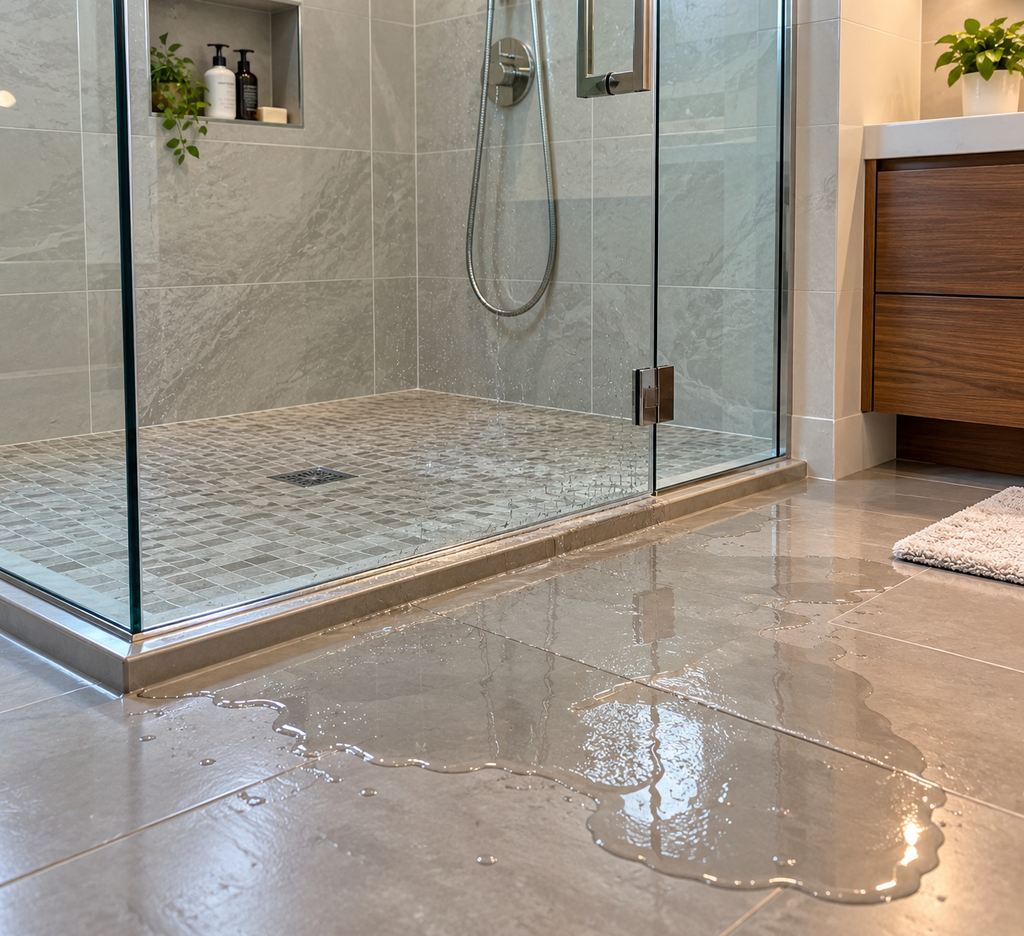
When the Bathroom Floor Slopes Toward the Shower
Sometimes the shower is fine and the floor is the culprit. Older homes settle, and a bathroom floor that tilts toward the shower collects any stray water along the door. Set a marble or a few drops of water on the floor outside the shower. If they drift toward the door instead of away, the floor is guiding water to exactly that spot. The shower may still be leaking a little, but it won’t feel like much because the water is concentrating there. In that case, fix the small leak first and address floor slope only if the problem persists.
The Drain That Can’t Keep Up
If water rises around the drain during a normal shower, the drain is not clearing fast enough. When the pan fills, water can reach the curb and spill. Hair and soap residue are the usual cause.
Remove the drain cover (many just lift off or have a single screw) and pull out visible hair with a plastic drain tool or tweezers. A plastic drain snake works for clogs further down. Be cautious with chemical drain cleaners. They can splash, can damage certain pipes and finishes, and should never be combined. If you do use one, follow the label’s instructions, ventilate the room, and keep children and pets away. A plunger or a mechanical tool is a safer first choice.
If the drain clears but still drains slowly, the problem may be deeper in the line. A vent issue or a partial blockage calls for a plumber.
Water That Drops Off the Door When You Open It
Some puddles appear only after the shower ends, when someone opens the door and a sheet of water drops from the glass or the frame onto the floor. This is less about leaks and more about water retained in places the door can’t drain: the hollow channel of a framed door, the top track of a sliding door, or the hinge cavities of a hinged one.
If the puddle shows up when you step out, not during the shower, this is probably what is happening. Squeegee the glass before opening, or wipe the sweep and the bottom edge. Check whether any frame channels have drain slots and whether they are blocked.
When the Water Is Leaking From Somewhere Else
If the floor is wet when the shower hasn’t run, or if the shower aimed at the wall still produces a puddle, the water may be coming from something other than the door.
Possible sources:
- A failed shower pan or waterproofing layer. Water can pass through cracked grout or a damaged membrane, travel under the tile, and emerge at the curb or the base of the door.
- A leaking valve, supply line, or drain connection. These can drip inside the wall or under the floor and surface near the shower.
- Cracked or missing grout or caulk around the base of the shower.
- A toilet or sink supply line. A slow leak can travel along the floor and collect at the lowest point.
Signs that deserve attention include a musty smell, persistent dampness after the shower is dry, swelling baseboards, loose or hollow-sounding tiles, staining on the ceiling below, or soft spots in the floor. These point to moisture getting into the structure. If you see any of them, don’t treat it as a door problem. A plumber or waterproofing contractor should check it, and a moisture meter can confirm whether materials are wet.
How to Replace a Door Sweep
Replacing a sweep is a manageable job if you take your time.
Measure first. Measure the glass thickness and the width of the door bottom. Check the existing sweep for a brand name or a product number, which makes matching easier.
Remove the old sweep. Most pull off the bottom edge of the glass. Pull slowly from one end. If it’s glued, slide a plastic scraper or a thin plastic putty knife beneath it. Don’t use metal on glass, which can chip the edge.
Clean the edge. Wipe the bottom of the glass with isopropyl alcohol. Remove any hardened residue or old adhesive with a plastic scraper, and let the glass dry completely.
Test-fit the new sweep. Hold it against the door before cutting. Leave the sweep slightly longer than the glass, then trim to size with sharp scissors or a utility knife after fitting.
Install it. Slide or press the sweep onto the edge, starting at one end. Work along the bottom until it sits flush, making sure the drip rail (if it has one) faces inward, toward the shower.
Check the clearance. Open and close the door. The sweep should touch the curb lightly without dragging. If it scrapes, replace it with a shorter one or trim it.
Test with water. Pour a cup of water down the glass and watch what happens at the bottom. If it still runs under, the gap may be too tall for that sweep.
Resealing Joints Without Trapping Water
Caulk and silicone fail slowly, and gaps in them let water into seams the door was never meant to cover. When resealing:
- Remove the old sealant completely with a plastic scraper or a sealant remover. New silicone doesn’t bond well to old.
- Clean the surface with isopropyl alcohol and let it dry.
- Use 100% silicone sealant rated for kitchens and bathrooms. Mildew-resistant formulas exist, but follow the label.
- Apply a thin, continuous bead and smooth it with a gloved finger or a tool.
- Allow the full cure time listed on the product before using the shower. This is often 24 hours but varies by product.
Avoid sealing everything. A sliding door’s weep holes need to stay open, and sealing the inside edge of the track can trap water. A frameless door’s bottom gap should not be filled with caulk, which can stop the door from moving and leave water trapped on the glass side. When a manufacturer’s instructions say where to seal, follow them.
Do Water Dams and Threshold Strips Work?
Adhesive water dams and threshold strips raise the effective height of the curb, and they do help in some situations, especially with low curbs and curbless showers. They also have limits:
- They can create a trip hazard, especially for children and older adults.
- Moisture can collect beneath them, encouraging mildew.
- They need regular cleaning, and adhesive ones may peel over time.
- They don’t fix leaking seams, a bad sweep, or an outward-sloping curb.
They make the most sense when the curb is low and the rest of the enclosure is sound. A solid, permanent threshold built into the shower is a better solution than a stick-on strip, but it’s also a larger project.
Curbless showers are a different design. They rely on floor slope and glass coverage rather than a raised curb, and they often need a wider fixed panel to hold the spray. If a curbless shower sprays water outside, adding or extending a fixed panel is generally more effective than adding a dam.
Common Mistakes That Make It Worse
A few habits tend to prolong the problem:
- Using a towel as the solution. A towel along the base hides the leak and holds moisture against the floor and baseboard.
- Caulking the bottom gap closed. A frameless door needs clearance to move, and sealing it can trap water against the glass.
- Replacing the sweep without measuring the glass. A near-miss fit can look fine and fail in weeks.
- Ignoring a slow drain. It’s easy to assume the door is at fault when the pan is simply too full.
- Over-tightening hardware. Tempered glass can crack under pressure, and clamps and hinges should be snug, not forced.
- Skipping the test. Guessing leads to buying parts that don’t help.
When to Call a Professional
A few problems are worth handing to someone else:
- The floor remains wet after the door, sweep, and drain have been ruled out.
- You notice a musty smell, soft flooring, swollen baseboards, or ceiling stains below.
- The curb or pan slopes the wrong way.
- A heavy glass door sags, binds, or has hardware that no longer holds.
A plumber can trace a supply or drain leak. A tile or waterproofing contractor can evaluate a failing pan or curb. A glass installer can adjust or replace the door. Ask for a written estimate, and ask what test confirmed the cause before the work begins.
Keeping the Floor Dry Afterward
Most prevention is habit. Squeegee the glass after showers, wipe the sweep and the bottom edge once in a while, and clear the track and weep holes every month or two if you have a sliding door. Check caulk lines a couple of times a year and look for gaps or discoloration. Run the exhaust fan during and after showers so the room dries, and take note of any new puddle right away, since early signs are easier to trace than long-standing damage.
Frequently Asked Questions
Is a little water outside a frameless shower door normal?
Some splashing is common because these doors rely on a gap and a sweep instead of a full seal. A consistent puddle after every shower isn’t normal, and it usually points to a worn sweep, spray angle, or curb issue.
Can I fix this with caulk alone?
Only if the leak is at a joint, such as where a track or panel meets the curb. Caulk won’t close a door’s bottom gap or correct a curb sloping outward.
Why does it only leak sometimes?
Variation in spray angle, water pressure, or who is using the shower can change how much water reaches the gaps. A partly clogged drain can also make the problem appear only during long showers.
Should I worry about water damage?
It depends on how long it has been happening. A few splashes that dry quickly are less of a concern than a recurring puddle that soaks the floor or baseboard. Repeated moisture can affect flooring and the subfloor, so it’s worth fixing early.
Final Thoughts
Start by finding out where the water leaves the shower: under the door, through a seam, over the curb, out of a track, or from somewhere else entirely. A dry floor, a spray aimed at the wall, and a cup of water poured down the glass will answer most of that in a quarter of an hour. The cheap causes (a worn sweep, a clogged track, a blocked drain, a showerhead aimed at the door) are the likeliest ones, and they are worth ruling out before spending money on anything bigger. If the floor stays wet with the shower off, or if the room smells musty, stop treating it as a door problem and get a professional to check for a leak.