
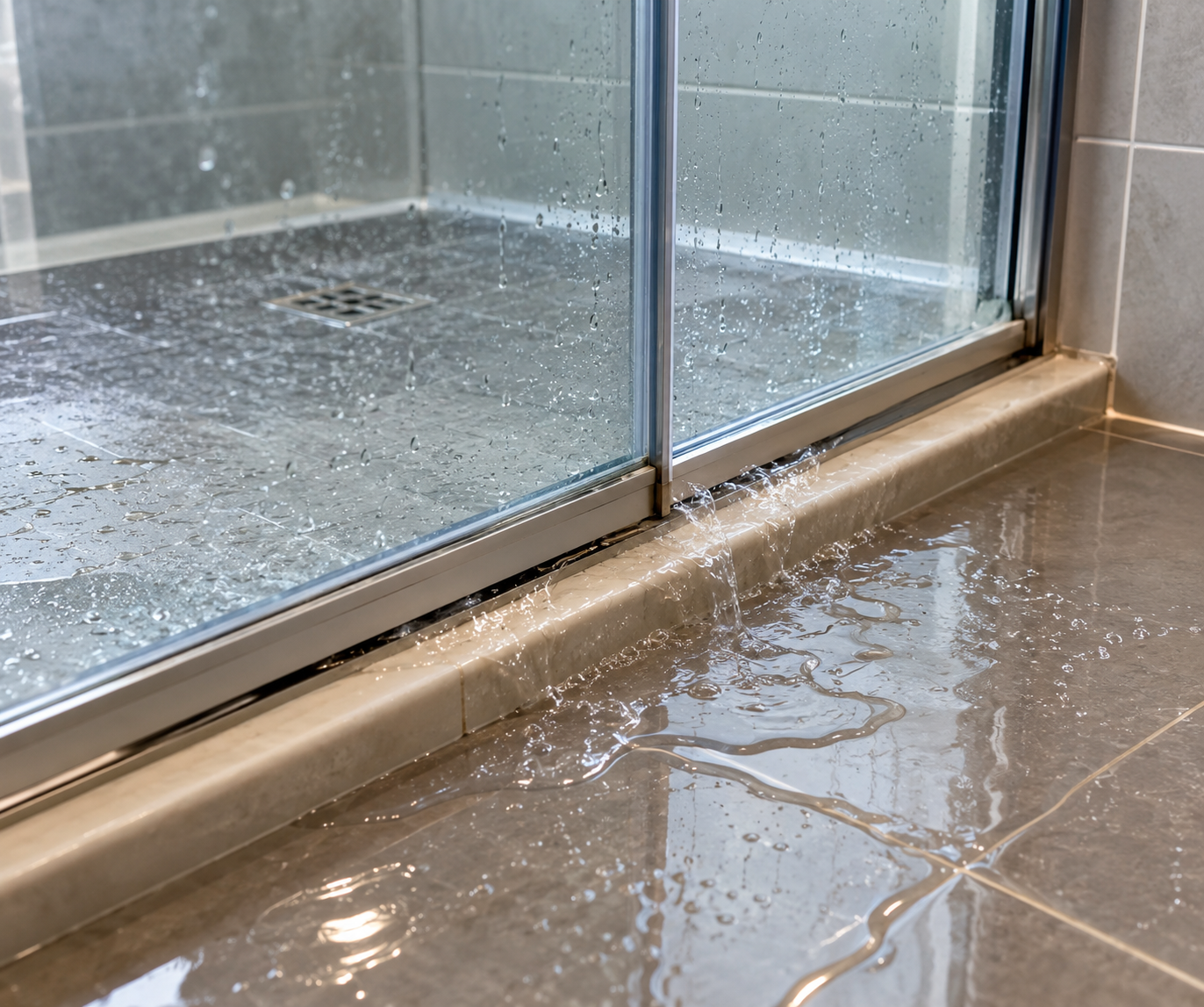
A puddle on the bathroom floor after a shower doesn’t always mean the door is broken. Water escapes in a handful of ways: under the bottom edge, around the hinge side, through a gap at the curb, or from spray that never touches the glass at all. Each one has a different fix. Swapping a sweep when the real problem is a gap in the sealant is a common way to spend money and still end up with wet socks.
So the first job is working out where the water is coming from.
Find Out Where the Water Is Actually Escaping
Dry the floor and the door completely. Put a dry towel or sheet of paper towel along the outside of the door, then run the shower for a few minutes at normal temperature and pressure. Check the towel afterward.
- Wet along the bottom edge only: the gap under the door is too large, or the bottom sweep is worn, missing, or the wrong shape.
- Wet near the hinge or wall side: the vertical gap between the door and the wall or fixed panel is letting spray through.
- Wet at the corners of the curb: the sealant has failed, or the curb or threshold has a crack or low spot.
- Wet in a pattern that matches where the showerhead points: the water is overshooting, and the door may be fine.
- Wet only after long or strong showers: the shower pan or curb may not slope properly toward the drain, so water pools and rises over the lip.
For a closer look, stick strips of painter’s tape on the outside of the glass at the suspect spots. Water that gets past the door will show up as a clear wet line on the tape.
Why Gaps Under a Door Let So Much Through
Frameless glass doors need a gap at the bottom to swing without scraping the curb, and that gap is the usual culprit. A small gap still moves a surprising amount of water when it has a hard-running spray behind it. Water also clings to glass and travels down it, so even a door that blocks the spray can run droplets straight into that gap.
Framed sliding doors work differently. They run on a bottom track with small drainage holes, often called weep holes, that let water that collects in the track drain back into the shower. This matters for the fixes below: if someone has sealed those holes, water can stack up in the track and spill over.
Replacing or Adding a Bottom Sweep
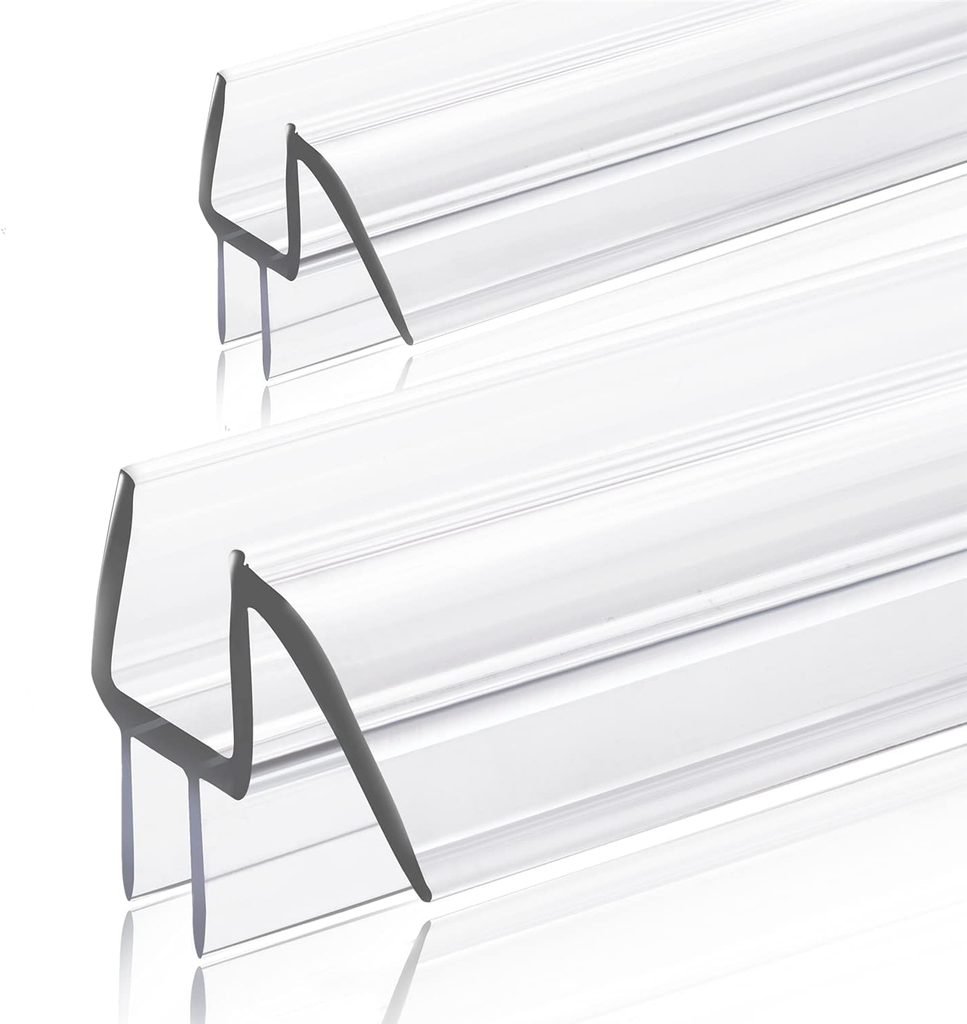
For a hinged or pivot door with a visible gap underneath, a bottom sweep is the first thing to try. It’s cheap and usually takes minutes to install.
Match the sweep to the glass. Sweeps are made for specific glass thicknesses, commonly 1/4 inch, 3/8 inch and 1/2 inch, so measure your glass before buying. A sweep that doesn’t grip properly will slide off or leave its own gap.
Choose a design that fits the gap size.
- A fin or wiper sweep has a flexible blade that bridges small gaps, and it suits doors that sit close to the curb.
- A bulb or bubble sweep has a rounded seal that compresses against the curb, and it copes better with a slightly uneven curb.
- A sweep with a drip rail (a raised lip on the outside face) helps with water that runs down the glass, because the lip catches it and sends it back into the shower. It does less when the problem is spray blasting through a gap.
Check clearance before committing. The sweep must clear the curb when the door opens and closes. If the door scrapes after installation, the sweep is too tall for the gap. Try a smaller profile instead of forcing it.
Old sweeps harden and crack over time, so if yours is stiff, discolored or no longer touches the curb evenly, replace it even if it isn’t visibly broken.
Sealing Gaps With Silicone, and Where Not to Seal
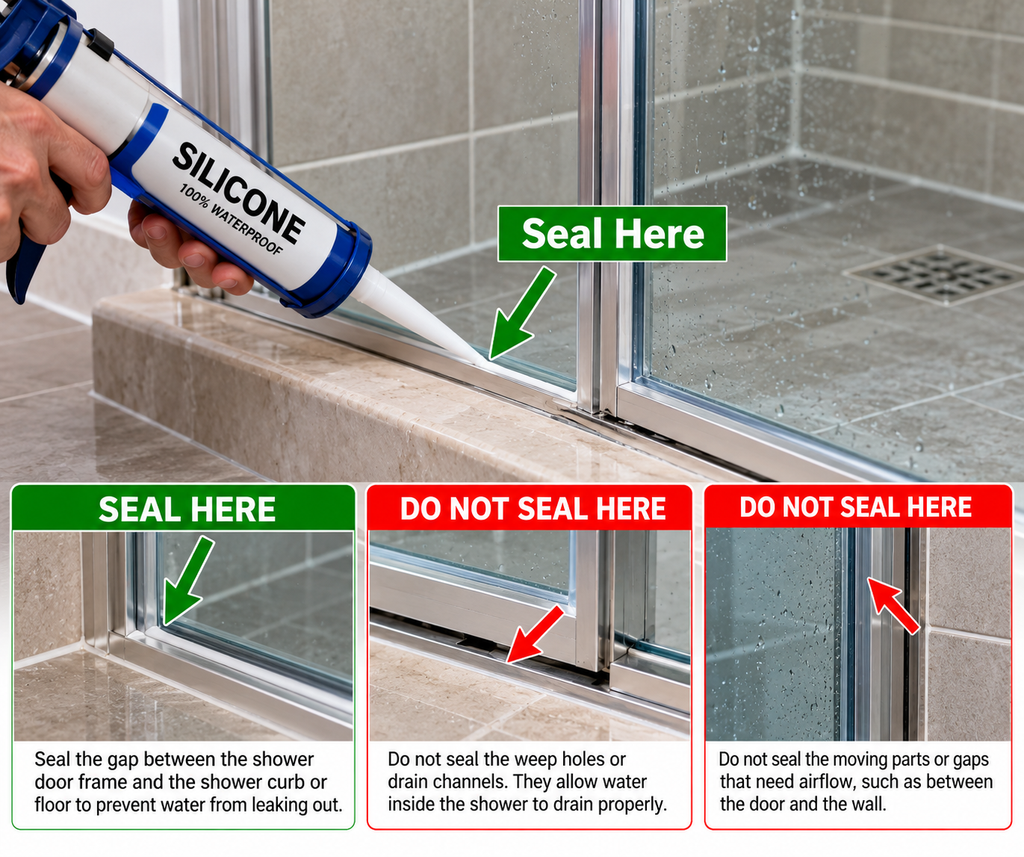
Gaps in the sealant at the base of the curb, along the glass-to-wall joints and at panel edges let water through quietly. The material that fits this job is 100% silicone sealant labeled for kitchen and bath, which stays flexible and resists mildew. Standard painter’s acrylic caulk isn’t made for constant soaking and tends to shrink and peel in a shower. If a product’s label doesn’t say it’s suited to wet areas, skip it.
The basic process:
- Remove the old sealant completely with a plastic scraper or razor blade tool, taking care not to scratch glass or chip tile.
- Clean the surfaces with isopropyl alcohol and let them dry fully. Silicone won’t hold on a damp or soapy surface.
- Run painter’s tape along both sides of the joint for a clean line.
- Apply a thin, even bead, smooth it with a gloved finger or a tool, and pull the tape before the silicone skins over.
- Keep the shower dry for as long as the product label says. Cure times vary by brand, and some call for 24 hours or more.
Silicone releases fumes while it cures, so ventilate the room, and read the label for gloves and skin or eye precautions.
Be careful about what you seal. Sealing the inside edge of a curb, where the metal channel or glass meets the base, keeps water from running under the channel. Sealing every edge, including the outside, can trap water that gets in anyway, which then sits against the base and can feed mold. Many installers prefer sealing the inside of the shower and leaving the outer edge unsealed, so any water that slips past has a way out. Practices differ between door types and manufacturers, so check the instructions that came with your door. If you don’t have them, search the manufacturer’s site for your model.
Never fill weep holes in a sliding door’s bottom track. They’re there on purpose.
Dealing With Gaps at the Hinge Side and Between Panels
If the towel test showed wetness near the hinge or the wall, the problem is a vertical gap. A clear vinyl strip or a magnetic seal along the door edge can close it. For framed doors, replacement vertical seals are usually sold by the door manufacturer or as universal strips you can trim to length.
Frameless doors are fussier because the hinge position is part of the design. A thin gap is normal there. If it’s wider than you’d expect, the door may have dropped slightly on its hinges over time, and tightening or adjusting the hinges (according to the maker’s instructions) can pull it back into line. Don’t attempt to adjust heavy tempered glass on your own without a second person.
When the Door Isn’t the Problem
Several things that look like door failures aren’t.
Spray direction. If the showerhead points straight at the door, water will always find the edges. Turning the head toward the wall, or toward the middle of the shower, often cuts the splashing more than any new seal. A handheld head used at a lower setting makes a difference too.
Pressure. Very high flow creates splash and spray that bounces off tile and glass. If your pressure is high, a flow-limiting showerhead (check whether it’s compatible with your fixture) can help.
Curb height and slope. A low or worn curb lets water rise over it, and a shower floor that doesn’t slope firmly toward the drain will let water pool near the door. Standing water after a shower, particularly near the door, points to a slope problem. Retrofit shower dams, which are shaped strips that stick to the base to raise the barrier, are sold for this purpose. They add height but won’t fix the slope itself, and adhesives vary in how well they bond to different surfaces, so follow the product’s directions closely.
Drain issues. A slow drain can fill the shower floor until water has nowhere to go but over the curb. If the water is draining slowly, clear the drain before you touch the door.
Why Leaving It Alone Costs More Than It Seems
A little water on the floor looks harmless, but repeated moisture creeping past the door can soak into grout, flooring edges, baseboards and the subfloor beneath. Warning signs include:
- soft, swollen or discolored flooring or baseboards near the shower
- a musty smell that lingers after the room dries
- grout or caulk lines that stay dark or damp
- peeling paint or stains on the wall or ceiling below the bathroom, if there’s a floor beneath
If you see any of these, stopping the leak isn’t enough. A moisture problem inside the floor or wall needs proper inspection, and a plumber or contractor should look at it.
A Few Questions People Ask
Can I just use a towel or bath mat instead?
It protects the floor in the short run, but the towel stays wet and can become a place for mold to grow, and it does nothing about the water reaching the subfloor edges. Treat it as a stopgap.
Does a door sweep work on a frameless glass door and a sliding door?
Sweeps are designed for hinged or pivot frameless doors. Sliding doors use different seals and a bottom track, so look for replacement parts made for your door’s brand and model.
How long should a repair last?
That depends on the product and how heavily the shower is used. Sweeps and sealants are wear items, so check them every so often and replace them when they harden, crack or stop making contact.
Final Thoughts
Run a towel test first and let it tell you whether the fix is a new sweep, resealed joints, a closed side gap, or just a showerhead turned a few degrees. Replace worn sweeps, seal the inside of the base with proper silicone, keep weep holes open, and don’t ignore soft flooring or a musty smell near the shower, because by then the water has gone further than the door.