
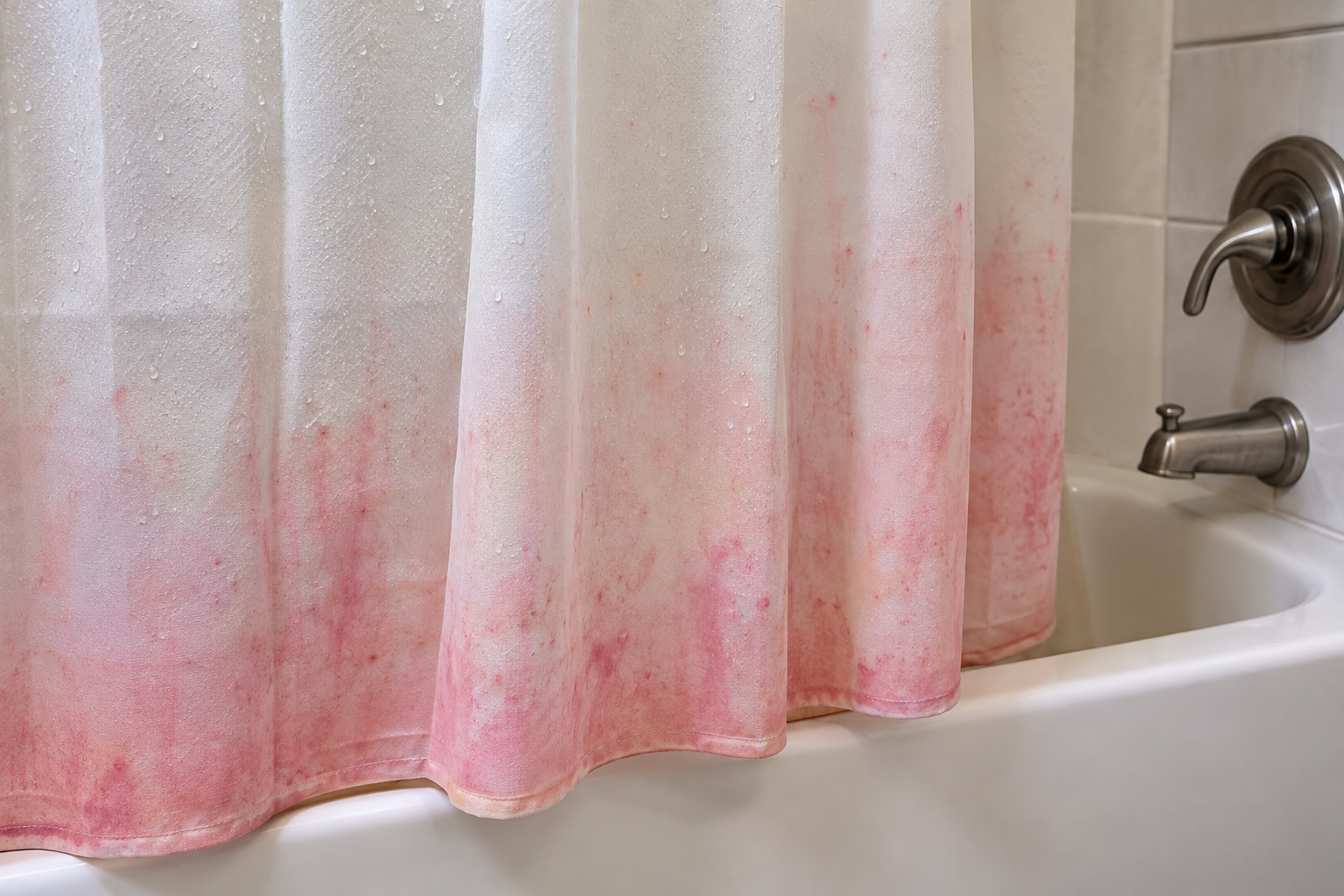
The pink usually appears low on the curtain first: in the folds near the hem, along the bottom edge that brushes the tub, or on the side that hangs against the wall. It looks like a faint rosy haze, sometimes orange-tinted, and it feels slightly slick. You wipe it and it smears. You wash the curtain and it comes back a few weeks later.
It’s not mold, and it’s not a dye bleeding from something. In most bathrooms the cause is a bacterium that colonizes damp surfaces and produces a red pigment. Knowing that changes what you clean, how often, and why scrubbing the curtain alone tends to fail.
What the pink film actually is
The most commonly cited cause is Serratia marcescens, a bacterium that produces a red pigment called prodigiosin. It’s found in soil, water, and damp indoor environments, and it grows well on surfaces that stay wet and carry a thin layer of organic residue. A shower curtain meets both conditions: soap, shampoo and body oils end up on it, and it stays damp for hours.
Some pink or orange films are caused by pigmented yeasts instead, such as Rhodotorula. Telling the two apart at home isn’t possible, and you don’t need to. The cleaning approach and the prevention approach are the same for both.
The pink growth is feeding on the film, not on the plastic or fabric itself. That explains why it’s concentrated where soap scum builds up (the lower third of the curtain, the hem, the folds) and why a freshly washed curtain can turn pink again quickly if the tub, the drain area, and the surrounding surfaces haven’t also been cleaned.
Pink, mold, rust, or something else?
Before reaching for bleach, check what you’re looking at:
- Pink bacterial film: pink, salmon or orange. Slimy or greasy to the touch. Wipes off with a damp cloth, at least partly. Often also appears at the tub drain, on grout lines, around the toilet water line, or on a toothbrush holder.
- Mold or mildew: usually black, dark green, or gray-brown. Appears as speckles or spots. It often looks fuzzy or leaves stains that persist after wiping, especially in fabric weave and the seams of vinyl liners.
- Rust staining: orange-brown rather than pink, and often tied to iron in the water or a rusting rod, ring, or can left on the tub edge. It tends to form streaks or rings, not a film.
- Dye transfer: a pink or red patch with a clear shape, usually where a colored washcloth, bath toy, or product bottle touched the curtain while wet.
If it’s mixed, say pink film plus dark spots in the seams, treat it as both. The mold part is what makes a curtain worth replacing rather than rescuing.
Is it harmful?
For most healthy adults the pink film is more of a nuisance than a hazard. Serratia marcescens is, however, a recognized opportunistic pathogen. Documented infections occur mostly in hospital settings and involve people who are already vulnerable: those with weakened immune systems, open wounds, catheters, or serious illness.
That’s a reason to clean it promptly and not leave it, particularly if anyone in the household is immunocompromised, very young, or elderly. If someone in the home falls into one of those groups and has ongoing health concerns, a doctor can give better guidance than a cleaning article can.
Cleaning a fabric curtain or liner in the washing machine
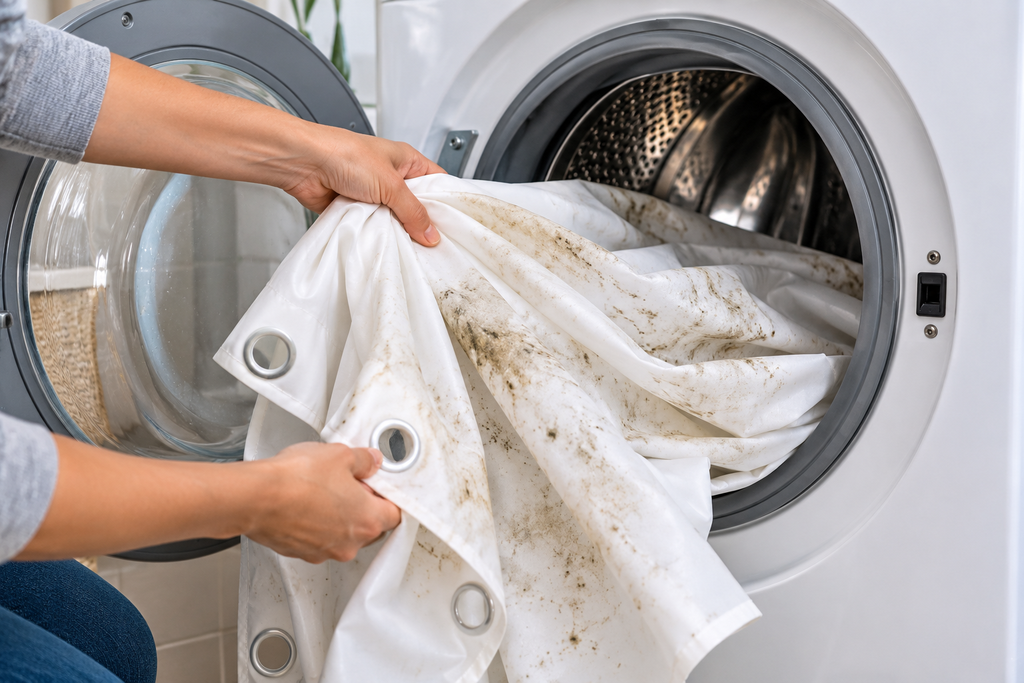
Check the care label first. Many polyester and nylon curtains and many plastic or PEVA liners are labeled as machine washable, while some vinyl liners are not or specify cool water only.
A common approach, and one that’s low risk for most curtains:
- Wash on a warm or cool, gentle cycle with your usual detergent. Add a few old towels. They act as a gentle scrubber against the curtain and reduce creasing and sticking.
- Add a cup or so of white vinegar or about half a cup of baking soda to the cycle, but not both at once, because they neutralize each other. Vinegar helps loosen soap scum and mineral deposits. Baking soda helps with odor.
- If the label allows it and the curtain is white or colorfast, an oxygen bleach (sodium percarbonate) product used per its directions is more effective than vinegar on organic film.
- Don’t put plastic or vinyl in the dryer. Heat can warp or melt it. Hang it back on the rod to dry while it’s slightly damp, and smooth out the folds with your hands.
Cleaning by hand when the curtain can’t go in the washer
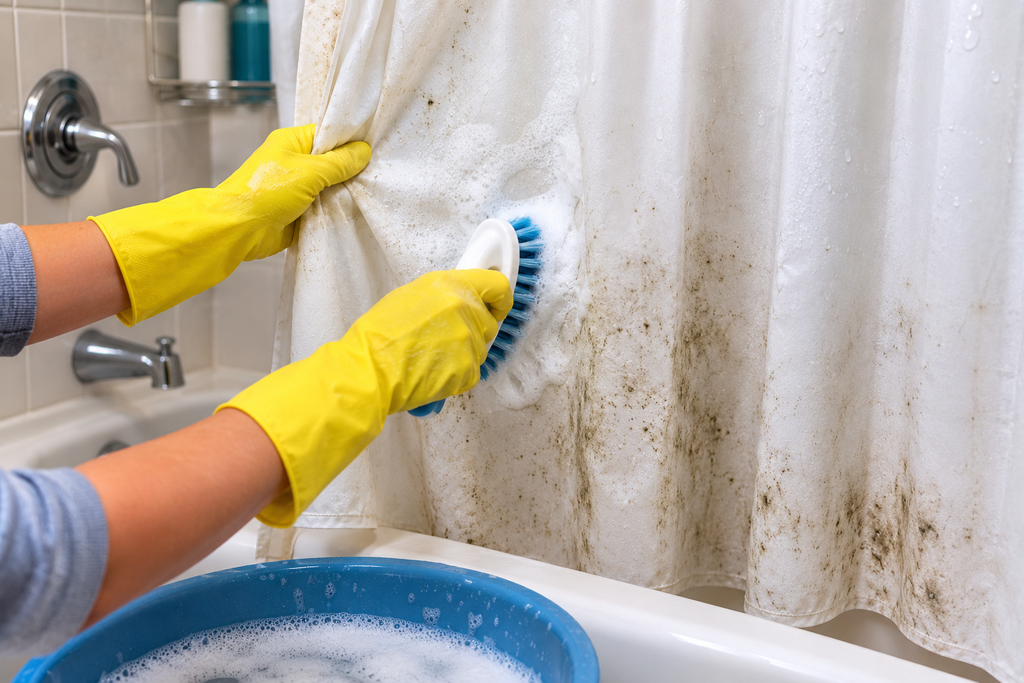
For a curtain you can’t machine wash, or one with a heavy pink band at the bottom:
- Lay it flat in the tub or hang it and spray it with a mix of warm water and a little dish soap, then scrub the stained areas with a soft brush or sponge.
- For stubborn film, a diluted bleach solution is the most reliable disinfectant. Dilution recommendations vary by product and the strength of the bleach, so follow the label on your bottle instead of guessing. Test an inconspicuous corner first, because bleach can fade colors and weaken some fabrics and plastics.
- Rinse thoroughly with clean water and hang to dry.
Safety notes for any bleach use: open the window and run the fan. Wear gloves. Keep children and pets out of the room until it’s rinsed and aired. Never mix bleach with vinegar, ammonia, or any acidic or ammonia-containing cleaner, including some toilet bowl and tub-and-tile products. The combinations release toxic gases. If you used vinegar earlier in the day on the same surface, rinse it well first.
Hydrogen peroxide is a gentler alternative for light-colored curtains, though it can bleach colors and is less dependable on heavy buildup.
When the stain won’t come out
Pink pigment can set into porous materials, especially older vinyl and fabric. If the color is still there after a proper wash and you’ve confirmed it isn’t coming from a surface you missed, the curtain is stained, not contaminated, and it’s a cosmetic issue. If it comes back in days, it’s reseeding from somewhere else. A liner costs little. If a curtain is cracked, sticky, or has dark mold in the seams, replacing it is usually quicker than another round of scrubbing.
Why it keeps coming back
The curtain is often the only thing that gets washed, but it’s rarely the only reservoir. Check these places:
- The tub and drain area. Soap scum on the tub wall and around the drain is a food source and a place the bacteria persist.
- Grout and caulk. Porous surfaces that stay damp hold biofilm. Pink caulk lines are a common sign.
- Soap dishes, shampoo bottles, and shower caddies. Water pools underneath and stays there.
- The toilet bowl, sink drain, and pet water bowls. The same pink film appears at the water line.
- The air in the bathroom. The bacteria can be carried by splashing and aerosolized water, so a single treated surface in a damp room doesn’t stay clean for long.
Cleaning the tub and its surrounding surfaces with a regular bathroom cleaner when you wash the curtain removes the source. If you only wash the curtain, you’re resetting a clock.
Keeping it away
Moisture and residue are the two things you can control.
Let the curtain dry. After a shower, spread the curtain fully open so it doesn’t bunch against itself or the tub. A folded curtain stays wet for hours. Pulling it across the rod rather than leaving it gathered at one end makes a real difference.
Ventilate. Run the exhaust fan during the shower and for some time afterward. Twenty to thirty minutes is a common recommendation, though how long it takes to dry depends on your fan and room. If there’s no fan, opening a window or door helps. If the bathroom is still visibly damp an hour later, the fan may be underperforming or undersized.
Reduce the residue. Bar soap tends to leave more film than liquid body wash, and hard water makes it worse. Wiping the lower part of the curtain and the tub walls with a squeegee or cloth after showers takes seconds and removes a lot of what the bacteria would feed on.
Wash on a schedule. A monthly wash for a curtain that’s used daily is a sensible starting point. Adjust it to how quickly the film comes back. A wipe-down of the tub every week or two matters more than people expect.
Consider the material. A fabric curtain with a separate liner lets you wash them separately. Mildew-resistant coatings on some liners may slow growth but won’t stop it if the curtain stays wet and dirty, so treat them as a help, not a fix.
What to do this week
Wash the curtain according to its label. Clean the tub, drain area, grout, and caulk at the same time. Hang the curtain fully spread out afterward, and run the fan after showers. If the pink is back within a couple of weeks despite all of that, look for a hidden damp spot, check the ventilation, and replace the liner.